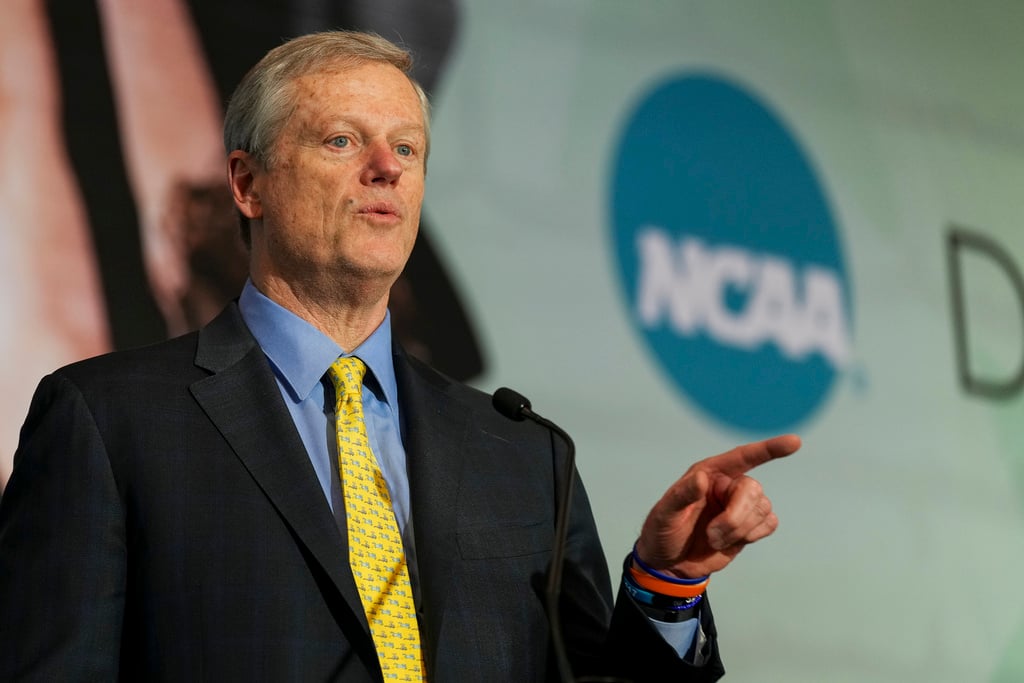
NCAA President Charlie Baker used the opening of March Madness to escalate concerns about prediction markets, warning the platforms “have much more to do” regarding sports integrity and said the association could pursue additional action if federal regulators fall short.
Speaking Wednesday on CBS Mornings, Baker said the NCAA is engaging with the Commodity Futures Trading Commission but made clear the organization is prepared to go further.
“If we don’t get anywhere with them we’ll explore other options to deal with that,” Baker said, referring to a recent letter the NCAA submitted as part of the CFTC’s public comment process on proposed event contract rules.
More than 30 states, including Nevada, New Jersey, and Maryland, have taken legal action against prediction markets, arguing their products are not federally regulated derivatives, but unlicensed sports betting under state law.
March Madness rehashes integrity concerns
March Madness arrives with more than $3.3 billion projected to be wagered at legal sportsbooks, according to the American Gaming Association.
At the same time, prediction market activity continues to scale rapidly. Kalshi has taken more than $50 billion in trading volume over the past 12 months, according to LSR research, with 85% tied to sports event contracts and roughly 15% tied to men’s and women’s college basketball.
That growth has heightened concerns about whether markets that operate outside state sports betting regulations can adequately safeguard against rising integrity risks, particularly in college sports.
NCAA calls for end to prop bets
In January, federal prosecutors charged 26 individuals in a college basketball point-shaving scheme, involving 39 players across at least 17 Division I programs, several of whom have since been ruled ineligible or disciplined by the NCAA.
“We catch players doing a variety of things associated with, usually underperforming on prop bets,” Baker said, pointing to recent enforcement cases that have resulted in athletes being removed from programs.
The NCAA has repeatedly pushed states to eliminate college player prop betting, arguing it creates direct incentives for harassment and manipulation.
Baker described “thousands and thousands” of abusive messages directed at athletes, coaches, and officials during championship play, adding the NCAA monitors and reports severe cases to platforms and payment providers.
Baker talks prediction markets, betting differences
The NCAA president reiterated concerns raised in his letter to the CFTC, pointing to differences between prediction markets and regulated sportsbooks.
“First of all, you can start doing it at the age of 18,” Baker said. “[In] almost every state you can’t gamble legally until you’re twenty or twenty-one, that’s problem number one. Problem number two is they don’t collect the kind of data that you’re required to collect if you’re a sportsbook.”
That data includes geolocation tracking, detailed wagering logs, and cross-operator reporting, which are routinely shared with integrity monitoring firms such as IC 360 and Sportradar under state law. Those systems have been critical in identifying suspicious betting patterns tied to high-profile cases across the NCAA, NBA, and MLB.
“I think they have, in many respects, much more to do in this space,” Baker said. “They said they would publish our letter as part of their public comment period and we’re looking forward to having a discussion with them.”