MGM Resorts and Caesars Entertainment have no plans to follow DraftKings or FanDuel into prediction markets, as casino executives warn that doing so could jeopardize their larger businesses.
MGM CEO Bill Hornbuckle and Caesars CEO Tom Reeg raised concerns about prediction markets Tuesday during a panel with Wynn Resorts CEO Craig Billings at the Global Gaming Expo in Las Vegas.
Their comments highlighted a growing divide in the gambling industry as online-first sportsbooks expand into federally regulated event contracts, including in states where sports betting is illegal.
MGM considered prediction markets
MGM considered entering prediction markets after the sector expanded into sports in early 2025, but quickly backed away over concerns about the rest of its business.
Nevada regulators “have absolutely said to us, ‘If you stretch out and do this, it’s going to impact your licensing,’ and we decided pretty quickly after that” not to enter the prediction market business, Hornbuckle said.
The Nevada Gaming Control Board has warned licensees that offering sports event contracts in other states could affect their suitability as well. Kalshi was successfully forced out in August after the Ninth Circuit found federal commodities law does not prevent states from enforcing gambling laws against prediction markets.
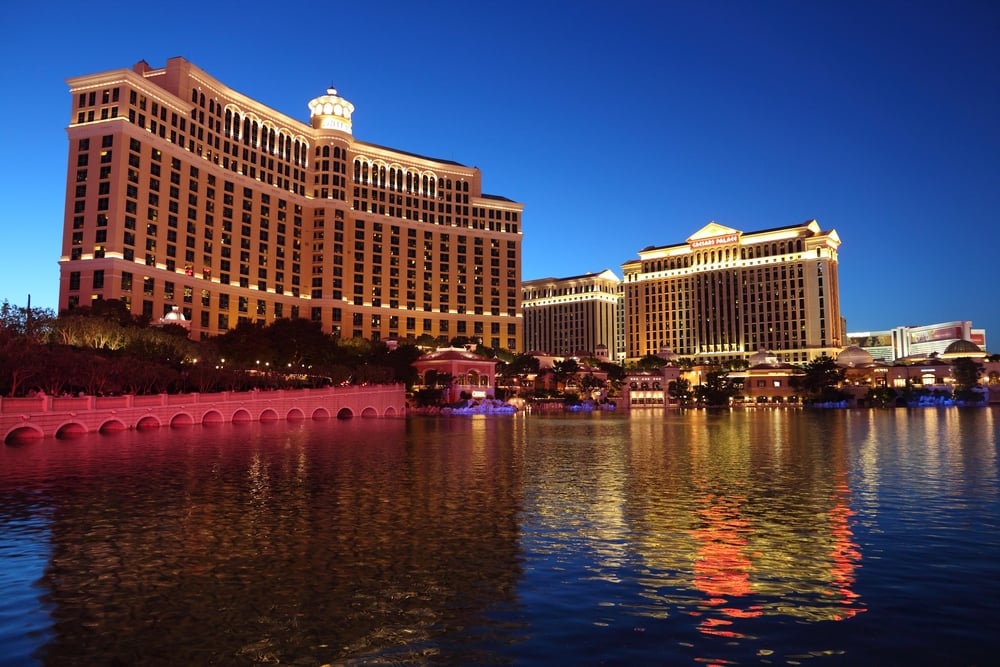
MGM operates nine casino resorts on the Las Vegas Strip, including Bellagio, Aria, Cosmopolitan, MGM Grand and Mandalay Bay.
Conceding potential first-mover advantage
Caesars has also explored prediction markets and is prepared to enter, but only if it can do so without jeopardizing its gaming licenses, Reeg has previously said. Caesars has eight Strip properties, including Caesars Palace, Paris Las Vegas and Planet Hollywood.
Reeg acknowledged that prediction market operators could be gaining an early advantage if sports event contracts eventually move into regulated gambling.
“We’ve lived through this before with [daily fantasy sports],” Reeg said. “Where DFS operated in a gray market, and PASPA was repealed and sports betting was legalized, and those that operated that business had a head start. And that would be the same, if places that do not have regulated gaming moved to regulated gaming and prediction markets are no more. Those that operated that in this current situation would benefit.”
Wynn has less direct exposure after exiting the U.S. sports betting market in 2023. Billings said the company has “no skin in the game” but acknowledged their expansion could affect Las Vegas over time.
“I’m not commenting on the legality,” Billings said. “So no direct impact, but certainly indirect impact over time.”
MGM, Caesars question oversight
Hornbuckle criticized prediction markets for allowing customers as young as 18 to trade sports contracts in without paying state gaming taxes or operating under the same regulatory oversight as sportsbooks. The legal age to bet in many states is 21.
“The age is 18. No taxes, no jobs, and the cavalier approach by these guys [hurts] the industry, Hornbuckle said. “If they want to play by the rules and come to Nevada, god bless ’em.”
Reeg also raised concerns about prediction market oversight. He pointed to a Kalshi contract on whether Caesars would be sold in 2026. Despite having inside knowledge as Caesars CEO, Reeg said he saw nothing in Kalshi’s rules that would have prevented him from trading on the outcome.
“But there was nowhere in their rules that said I couldn’t place a bet,” Reeg said.
The concerns come as commercial casinos, tribal gaming groups and organized labor coordinate a broader campaign against prediction markets.
Industry split on prediction markets
DraftKings, FanDuel and Fanatics each launched prediction market products last year and left the American Gaming Association around the same time. The casino industry trade group maintains sports event contracts are illegal gambling and has backed efforts to stop them amid dozens of legal challenges nationwide.
The legal landscape has shifted in recent weeks. Federal appeals courts in the Sixth and Ninth circuits have ruled that states can enforce gambling laws against prediction markets. The Third Circuit reached the opposite conclusion in a separate New Jersey case.
New Jersey has asked the U.S. Supreme Court to review that decision.