
Nevada continues the fight against Kalshi to keep sports prediction markets out of the state.
Kalshi, which recently hit significant volume milestones, is not complying with the preliminary injunction the Nevada Gaming Control Board won against it earlier this year by enabling a geofence that does not allow trading sports contracts in the state, according to the NGCB.
The regulator asked the First Judicial District Court for the State of Nevada to issue an order requiring Kalshi to appear and show cause why the company should not be held in contempt for violating the Court’s preliminary injunction order. According to the NGCB:
Kalshi has not complied with the Court’s May 18, 2026, order requiring Kalshi to geofence its operations so that it does not offer or facilitate the offering of any sports-, election, or entertainment-related event contract to anyone located in Nevada. The Board asks the Court to enter a finding of contempt and to impose significant monetary penalties for violation of the Court’s order.
How did we get here?
On Feb. 17, the NGCB filed a civil enforcement action against Kalshi in the District Court of Carson City, seeking “a declaration and injunction to stop Kalshi from offering unlicensed wagering in violation of Nevada law.” On March 20, the court issued a temporary restraining order in favor of the NGCB, resulting in Kalshi sending the following email to customers:
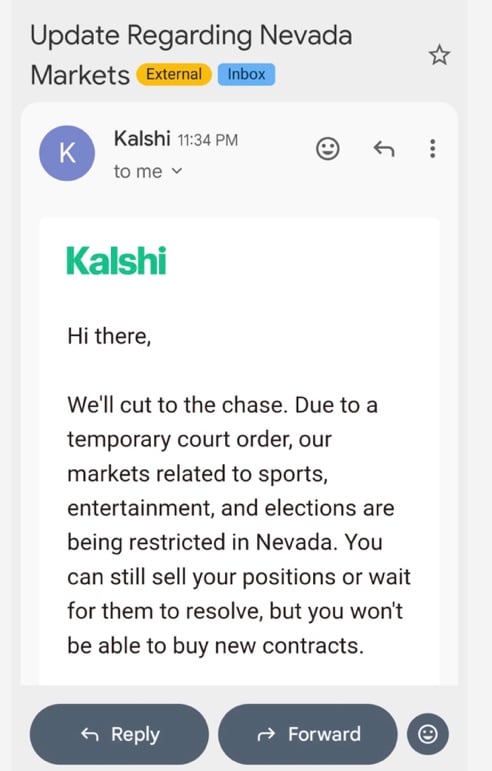
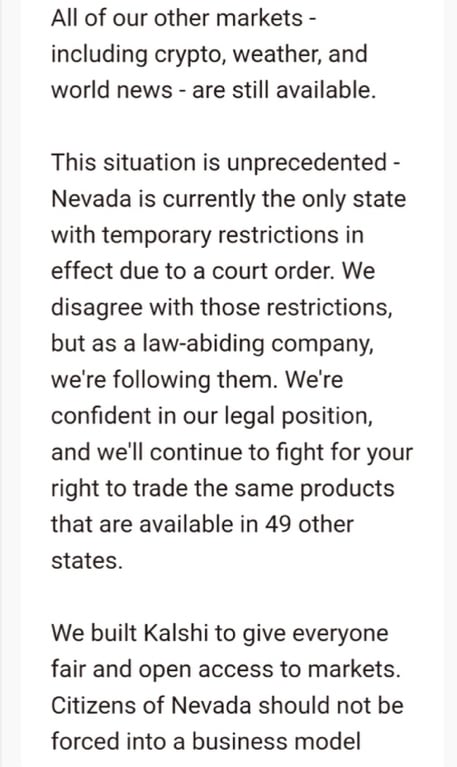

On April 28, the temporary restraining order was converted into a preliminary injunction that stated “Kalshi is prohibited from offering or facilitating the offering of the following to Nevada residents”:
- Sports-related event contracts (i.e., those listed in Kalshi’s “Sports” tab), including event contracts involving the outcome of sporting events or any element of any sporting event (i.e., props) or any combination of elements or outcomes of sporting events (i.e., parlays);
- Election-related event contracts (i.e., those listed in Kalshi’s “Elections” tab); and
- Entertainment-related event contracts (i.e., those listed in Kalshi’s “Culture” tab).
The order gave Kalshi until May 4 “to make technological enhancements necessary to comply” with its terms and initially required Kalshi to restrict users “identified as Nevada residents.”
Per the NGCB’s application, on May 18, the Court issued an amended preliminary injunction order that “prohibited” Kalshi from “offering or facilitating within the State of Nevada” “[s]ports-related event contracts,” “[e]lection-related event contracts,” and “[e]ntertainment-related event contracts.”
Nevada’s grounds for contempt
The NGCB argues that the court should find Kalshi in contempt of the amended preliminary injunction order because the board’s investigators were able to purchase (on multiple occasion) various prohibited event contracts on Kalshi’s platform while physically located in Nevada.
Nevada Revised Statute §22.010(3) states “Disobedience or resistance to any lawful writ, order, rule or process issued by the court” shall be deemed contempt.
Notwithstanding, Nevada law requires that a contempt order be grounded on a party’s disobedience of an earlier order “that spells out the details of compliance in clear, specific and unambiguous terms so that such person will readily know exactly what duties or obligations are imposed on him.” See State, Dept. of Indus. Rels., Div. of Indus. Ins. Regul. v. Albanese, 112 Nev. 851, 855 (1996).
Kalshi tried blocking another way
Though the amended preliminary injunction states that Kalshi shall be prohibited from offering certain event contracts within Nevada, the order (as described in the NGCB’s application) does not clearly, specifically, or unambiguously spell out the means in which Kalshi is required to do so.
Rather, the NGCB acknowledges Kalshi’s attempted solution to block sports prediction markets access by preventing devices with IP addresses associated with Nevada locations, but states such efforts should not be respected for the following reasons:
- Kalshi utilized a substandard method of testing prior to launching its in-house geolocation system instead of engaging a “tried-and-tested” third-party vendor that other operators use to comply with state law.
- Kalshi did not contribute “significant monetary investment” towards its in-house geolocation system, having “spent just $190,000 on development, implementation, and testing.”
- Kalshi’s sole reliance on IP address-based geolocation is “technologically insufficient” because such methodology is not known to be reliable at the state level.
The NGCB argues that Kalshi’s failures are purposeful because the company previously stated: (1) reliance on its current solution would be unsuccessful because effective geolocation typically requires a combination of location-identifiers costing upwards of “tens of millions of dollars annually,” and (2) Kalshi lacked the capacity to implement this service without contracting with a cloud- or server-based geo-location platform.
Likely Kalshi defense
Nonetheless, Kalshi will likely point to the amended preliminary injunction order’s lack of specific compliance details, including no such requirement for the company to: (i) utilize rigorous testing or contract with a certain third-party vendor for the purpose of implementing geo-location, (ii) spend significant money, or (iii) use a particular/combination of systems or methodologies in order to comply with the court’s order.
Furthermore, in response to the NGCB’s publicizing of its application, Kalshi issued the following statement alluding to interference with attempted compliance: “We asked Nevada point blank for information about those 8 instances so Kalshi could review them and make any needed tweaks. They refused.”
Thus, before the court may find Kalshi in contempt, not only must the judge find that Kalshi’s in-house solution (or purported failure thereof) constitute disobedience of any clear, specific and unambiguous term contained in the amended preliminary injunction order, but in doing so it must also consider pertinent facts regarding whether such event contracts were purchased in a proper manner (i.e., not in attempt to circumvent Kalshi’s IP addressed-based geo-location system). Notwithstanding, disobedience of a court order is contempt and whether a violation of the court’s directive has occurred will be determined in accordance with the court’s discretion.