Kalshi is not OK with some claims made about it by a “nonpartisan market integrity watchdog.”
The prediction market operator has sent a demand letter to FairPredicts directing them to immediately remove defamatory statements relating to its “Kalshi Lies” campaign.
The letter states that the campaign “falsely portrays the structure and operation of Kalshi’s regulated exchange, falsely accuses Kalshi of deceptive and conflicted conduct, and falsely implies that Kalshi profits from customer losses through undisclosed self-dealing and manipulation of its own markets.”
What does Kalshi Lies claim?
FairPredicts focuses on four areas of accountability: false advertising, insider trading, anti-money laundering and market integrity. The group recently announced a six-figure advertising campaign that coincided with a Senate committee discussion regarding regulating prediction markets.
Kalshi Lies links directly from FairPredicts’ website, and is described as providing a “dedicated record of Kalshi’s documented deceptions.” Kalshi’s letter contends that the information published on the website is demonstrably false – specifically, calling out the following:
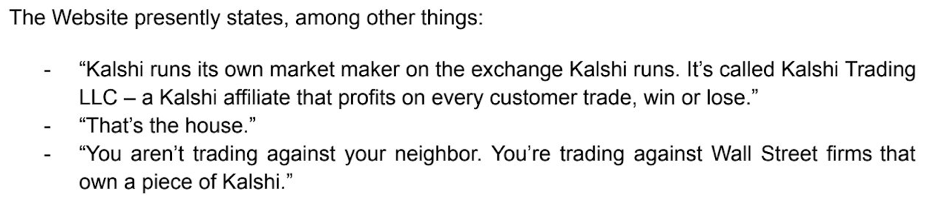
Kalshi claims that the aforementioned statements “constitute false statements of fact that directly impugn the integrity of Kalshi’s business, exchange operations, and regulatory compliance framework.”
The case for defamation
Multiple elements must be shown in order to establish defamation:
- a false statement that tends to expose a person to public contempt, hatred, ridicule, aversion, or disgrace
- published without privilege or authorization to a third party
- amounting to fault as judged by, at a minimum, a negligence standard
- either causing special harm or constituting defamation per se.
A statement constitutes defamation as a matter of law (i.e., “defamation per se”) if, among other things, it accuses the offended party of a serious crime or tends to injure the offended party’s trade, business, or profession.
Kalshi asserts that the statements are defamatory per se “because they accuse Kalshi of dishonest, deceptive, unethical, conflicted, and manipulative business conduct.” In response to the statements made on “Kalshi Lies,” the letter states:
- Kalshi Trading, LLC is not “the house,” because it does not: (i) guarantee profits from customer activity, (ii) profit “on every customer trade, win or lose,” or (iii) participate in every trade on the platform. Rather, Kalshi Trading, LLC serves as one of the many “market makers” engaged to provide liquidity to Kalshi’s exchange.
- Kalshi Trading, LLC does not profit from trading activity whatsoever, represents a minuscule level of trading volume on the platform, and actually operates at a loss.
- Neither all nor substantially all trading activity occurs against institutional actors.
Furthermore, Kalshi contends that FairPredicts has acted with “actual malice” because the page appears designed by its competitors and/or anti-prediction market proponents “to inflict reputational and commercial harm on Kalshi through knowingly false and inflammatory factual claims” spread with reckless disregard for the truth.
The case against defamation
Notwithstanding, truth is an absolute defense to defamation and it does not need to be established to a “literal degree” in order for the offending party to avoid liability. “Kalshi Lies” states that it is built upon publicly available information, including Kalshi’s corporate filings and investigative reporting. Additionally, statements based on opinion are non-actionable.
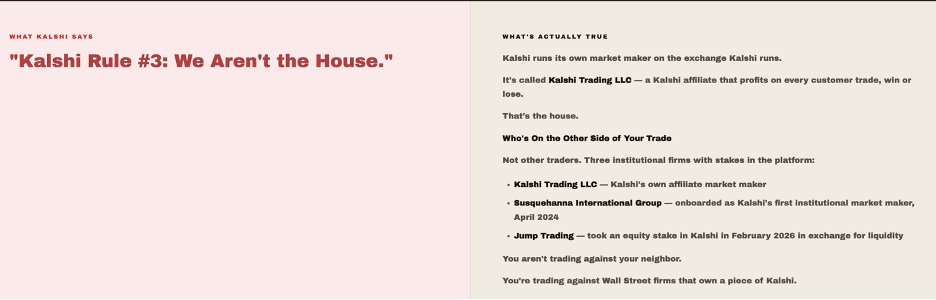
In any event, it have been made (assumably following FairPredicts’ receipt of Kalshi’s demand) according to the prior version of the page.
Before:
After:
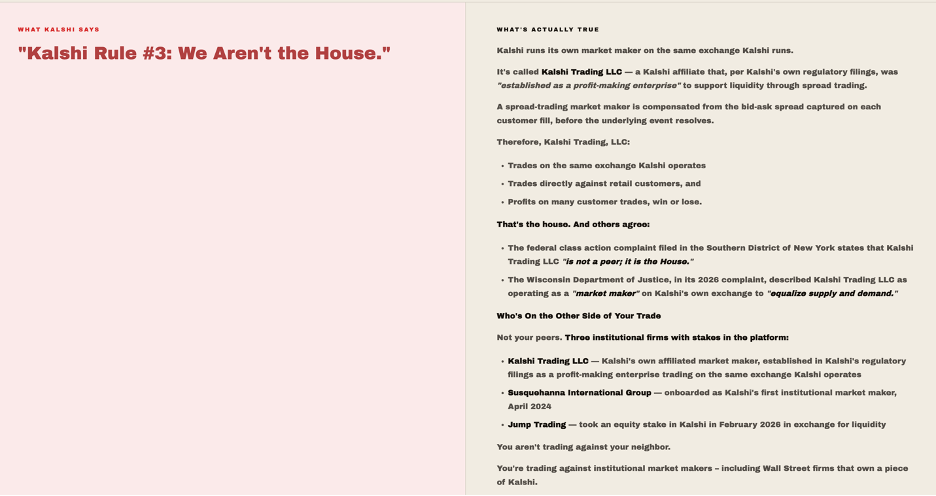
Noticeably, the post-letter version includes citations to corporate filings and allegations raised in various lawsuits as the basis of its information. Whether such suffices to alleviate Kalshi’s potential pursuit of legal action against FairPredicts remains to be seen.