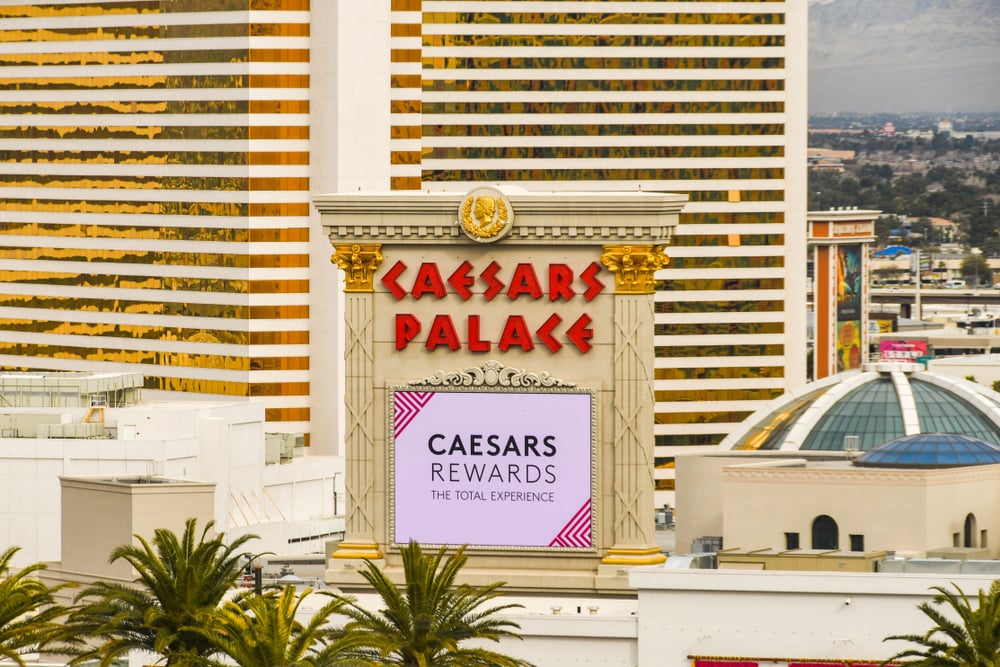
Caesars still has plenty of land-based casino customers to convert into online gaming and sports betting users, CEO Tom Reeg said.
Reeg made the comments on Tuesday’s first quarter earnings call, revealing Caesars has to win some of those players back from competitors.
“We continue to get better, but there’s still a gigantic opportunity in converting customers in our database that are primarily brick and mortar with us and play digitally elsewhere, and bringing them into the fold,” Reeg said. “When we first launched our app on the sports side and frankly, on the iCasino side before Caesars Palace Online, the experience lagged our peers. That’s no longer the case. So it’s going to those customers to get another look.”
Caesars boasts the industry’s largest database through Caesars Rewards with more than 65 million customers.
Its online casino and sports betting business reported 511,816 monthly unique players in the first quarter, up 2% year over year, while adjusted EBITDA climbed 60.5% to $69 million. It remains on track to generate at least $500 million annually, per Reeg.
Database keeping costs low
Earlier this month, BetMGM flagged rising customer acquisition costs from prediction markets fighting for the same customers as sportsbooks. That prompted the company to shift marketing spent more towards states with both sports betting and online casino.
Caesars is not feeling the same pinch.
“I know others have pointed to prediction markets as an impact on customer acquisition costs,” Reeg said. “Recall that the bulk of our customer acquisition comes from our Caesars Rewards database. That’s a particular advantage now. We’re not swimming in those same pools where prediction markets are making acquisition costs higher.”
Customers that play in person spend more after playing online
Reeg said brick-and-mortar customers who become online players end up spending more in-person as well.
“And what we find is brick-and-mortar customer that shows up in digital for us increases their brick-and-mortar spend with us,” Reeg said. “… The more places we touch you, whether that’s physical and digital, whether that’s multiple properties within a market or that’s multiple properties across market, the more times we touch you, the more valuable you become as a customer for us. So that’s a system-wide focus and effort.”
Caesars will begin providing Las Vegas visitors with more information about where Caesars Rewards can be used, including across its digital gaming platforms.
Can online revenue grow more?
Digital net revenue rose 15% in the quarter, below the roughly 20% growth rate Caesars Digital President Eric Hession said the segment can achieve.
“I think if you have mid-single-digit [sports betting] handle growth and then the iCasino side continuing to grow like it is, that’s how we can get to that 20% range,” Hession said.
Online casino handle jumped 20% to $5.4 billion in the quarter, while sports betting handle fell 3%. Sports betting hold reached 8.3%, up 1 percentage point year over year as Caesars works toward a long-term goal of 10%.
Hession noted that digital revenue does not need to reach 20% growth to hit its EBITDA targets.
Partnership expenses rolling off
Caesars still has $312 million in partnership obligations tied to long-term deals running through 2040, according to its 10-Q. Reeg has said those costs would gradually decline, helping improve margins.
The company had $51 million in partnership payments scheduled for 2026, with $34 million now remaining. Obligations drop to $31 million in both 2027 and 2028, $28 million in 2029, and $24 million in 2030.
“Also remember that we have some significant partnership expenses that roll off in ’26,” Reeg said. “The bulk of those benefits will flow to us in the third and fourth quarter of this year and then into the first quarter of ’27. So digital looks very strong.
“We’re still on the path that we laid out a long time ago toward $500 million or more of EBITDA. With the completion of our capital cycle, we’re in a free cash flow harvesting stage now.”
Caesars optimistic about Alberta
Caesars will have a “much more comprehensive launch plan” when it launches Alberta online casinos and sportsbooks on July 13 than it did for Ontario, Hession said.
While the province is smaller in population than Ontario with just over 5 million residents compared to 16.1 million, Alberta has a “fairly high average wealth per person,” Hession added.
Ontario does not provide market share details, but Hession described Caesars’ performance as “kind of middle down the road.” Alberta will include all three of Caesars’ platforms, including its two standalone casino brands Caesars Palace and Horseshoe.
Reeg expects online casino expansion
Momentum around online casino legalization can shift quickly and unpredictably, Reeg said, likening it to a “car accident that happens in your vicinity.”
Reeg pointed to Virginia, which quickly moved from being off the radar to a potential near-term legalization candidate before ultimately falling short. He cited a similar dynamic in Illinois.
“This stuff comes together very quickly as states get under stress, budget-wise and are looking for revenue,” Reeg said.
“… So, I think if you’re looking over kind of an intermediate time frame, I’m highly confident there’ll be more jurisdictions available to us. I just hesitate to predict which ones those would be.”