
Prediction Markets vs. Online Sportsbooks: A Side-by-Side Breakdown (October 2026)
Sports fans looking to add some stakes to the games they watch have two very different paths available: prediction markets and traditional online sportsbooks. Both let you back your opinion on how a game will go, but the mechanics behind each one work in pretty different ways. One is built around trading contracts that shift in price, and the other is built around fixed odds set by the house. It’s worth noting upfront that prediction markets aren’t limited to sports at all; they cover everything from politics to economic data, while sportsbooks stay focused entirely on sports and sports-adjacent events.
Prediction Markets vs. Online Sportsbooks: A Quick Comparison
| Feature | Prediction Markets | Online Sportsbooks |
|---|---|---|
| How it works | Buy and sell contracts tied to event outcomes | Place a wager at odds set by the book |
| Who regulates it | CFTC (federal) | State by state |
| Typical payment methods | Bank transfer, debit card, crypto, PayPal | Debit card, PayPal, Venmo, Apple Pay |
| Can you exit early | Often yes, you can sell your position | Only if a cash out feature is offered |
| Best for | People who like tracking probability and want flexibility | People who want straightforward |
What Are Prediction Markets?
Prediction markets are platforms where people trade contracts based on what they think will happen in a future event. They work a bit like a stock market, except instead of buying shares in a company, you’re buying a position on an outcome, like whether a certain team wins a game.
Platforms like Polymarket, ProphetX, and OG let users buy “yes” or “no” positions on all kinds of events, with sports making up a large share of the activity. DraftKings and FanDuel have also entered this space, offering their own prediction market products alongside their more familiar sportsbook operations. It’s worth being clear that these are two separate verticals running under the same brand, not the same product with a different name.
DraftKings Predictions and FanDuel Predicts operate under prediction market rules and trade contracts the same way Polymarket or ProphetX do, while the sportsbook side of each app still runs on traditional fixed odds. Contract prices usually move between 1 cent and 99 cents, and that price reflects what the crowd currently believes is likely to happen.
How Contracts and Pricing Work
Say there’s a contract asking whether a certain team will win their next game. If most traders think they will, the “yes” price might sit around 65 cents. Buy that contract and get it right, and you’re paid $1 per contract. Get it wrong, and the contract is worth nothing.
So if you bought 10 contracts at 65 cents each, you’d spend $6.50, and a correct outcome would pay you $10. That $3.50 gap is your profit.
How People Actually Win Money
There are two main ways to make money on a prediction market. The first is holding a position until the event finishes and hoping you picked the right side. The second is trading in and out before the event ends, buying low and selling high as the price shifts based on new information.
That second approach is what separates prediction markets from a typical wager. Some users never wait for a final result at all. They watch the price move and cash out early the moment it swings in their favor.
What Are Online Sportsbooks?
Online sportsbooks are the more traditional way to bet on sports, just moved from the counter at a physical shop onto your phone or computer. Instead of trading a position, you place a wager at fixed odds set by the book, and if the outcome you picked comes in, you get paid based on those odds. Once you place the bet, the odds you locked in are the odds you’re stuck with, whether the game shifts in your favor or against you afterward.
BetMGM, DraftKings, Caesars and FanDuel are some of the biggest names in the space, and all three offer mobile apps that let you bet on just about any major sport in states where they’re licensed to operate.
How Odds and Payouts Work
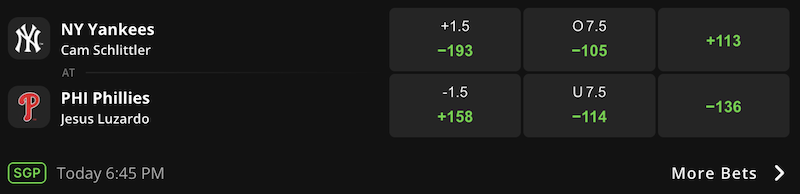
Odds are usually shown as a plus or minus number. A negative (-) number tells you how much you’d need to bet to win $100, and a positive (+) number tells you how much you’d win on a $100 bet. So odds of -136 mean you’d need to bet $136 to win $100, while odds of +113 mean a $100 bet would win you $113 in profit. The book builds in a margin on both sides of a bet, which is part of why the numbers rarely feel like a perfect coin flip even on close matchups.
How People Actually Win Money
Winning at a sportsbook comes down to picking outcomes better than the odds suggest you should. If a book prices a team at -150 and that team actually wins more often than the odds imply, betting that side repeatedly should pay off over time. There’s no trading or adjusting involved, just picking well and letting the bet play out to the end.
Prediction Markets vs. Online Sportsbooks: Key Differences
Once you understand how each one works, a few clear differences start to stand out.
What You’re Actually Wagering On
With a prediction market, you’re taking a position on whether something happens, priced by the collective view of everyone trading that market. With a sportsbook, you’re accepting odds that the house has already calculated and baked its margin into, and those odds don’t move again once you’ve placed your bet.
Fixed Odds vs. Moving Prices
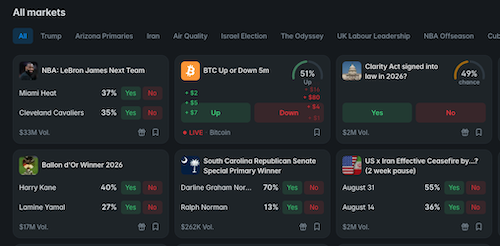
This is probably the biggest structural difference between the two. A sportsbook bet is locked in the second you place it. A prediction market position keeps moving in price the entire time the market is open, which means you can watch your position gain or lose value well before the event is even over.
Regulation and Legal Status
Prediction markets fall under the Commodity Futures Trading Commission, a federal regulator, which is part of why platforms like Polymarket and ProphetX can operate in states where sports betting isn’t legal yet. Sportsbooks are regulated at the state level, which is why BetMGM, DraftKings, and FanDuel aren’t available everywhere and often have different rules and bet limits depending on the state you’re in.
Online Sports Betting vs. Prediction Market Apps: Market and Betting Variety
The range of things you can actually bet or trade on looks pretty different depending on which platform you’re using.
Prediction Market Categories
Beyond sports, prediction markets let you trade on politics, economic data, entertainment outcomes, and other current events. Within sports specifically, markets tend to focus on game winners, series outcomes, or season-long results rather than deep, granular bet types.
Sportsbook Bet Types
Online sportsbooks offer a wide range of ways to wager, and not all of them are tied to a single game. Some bets settle the same day, while others can take an entire season to play out.
- Moneyline bets: simply picking who wins the game
- Spread bets: add a point handicap to make a lopsided game more even
- Over-under bets: predicting whether the combined score lands above or below a set number
- Live bets: wagers placed while the game is already underway, with odds updating in real time
- Parlays: combine multiple bets into one ticket for a bigger payout, though every leg needs to hit for it to pay out at all
- Futures: longer-term bets on outcomes like a championship winner or MVP, placed weeks or even months before the result is known
Costs, Fees, and Vig
Neither option is free to use, and understanding how each one makes money helps explain what you’re actually paying for.
How Prediction Markets Charge You
Most prediction markets charge fees tied to trading activity. That can include a small percentage on deposits, a fee per contract traded, or a wider spread on markets that don’t see much volume. These fees are usually small individually, but they add up the more active you are.
How Sportsbooks Build In Their Cut
Sportsbooks don’t charge a visible fee, but they build their cut directly into the odds, commonly called the vig or the juice. That’s why two evenly matched teams are rarely priced at exactly +100 and -100. The book shades both sides slightly so it keeps a profit regardless of who wins, even if you never notice the fee directly.
Getting Started: Sign-Up and Verification
Opening an account is usually the easy part, but how much you need to provide upfront varies between the two.
Opening a Prediction Market Account
Signing up for a prediction market tends to take a bit longer. Most platforms require identity verification right away, which means uploading a government ID and sometimes a selfie to confirm it matches. This is standard on platforms like Polymarket and OG, and it can take anywhere from a few minutes to a couple of days.
Opening a Sportsbook Account
Sportsbook sign-ups move fairly quickly too, though you’ll still need to verify your identity and confirm your location, since betting is tied to where you physically are, not just where you live. BetMGM, DraftKings, and FanDuel all use geolocation to confirm you’re in a state where betting is legal before letting you place a wager.
Deposits, Withdrawals, and Wallets
Prediction markets often support both crypto and traditional payment methods, and some require managing a wallet, whether that’s built into the platform or an external crypto wallet you connect yourself. Withdrawal speed depends on the method, ranging from minutes for crypto to a few business days for fiat transfers.
Sportsbooks mostly stick to standard payment methods like debit cards, PayPal, and Venmo, with your balance held directly in your account rather than a separate wallet. Withdrawals typically take somewhere between one and five business days, depending on the method and the book.
Flexibility: Can You Exit Early?
This is one of the clearest practical differences between the two. On most prediction markets, you can sell your position any time before the event resolves. If the price moves in your favor early, you can lock in a profit and walk away without waiting for the outcome.
Sportsbooks are more limited here. Some offer a cash-out feature on certain bets, letting you settle for a smaller guaranteed amount before the game ends. Still, it’s not available on every bet type and the offered amount is usually less favorable than the bet’s true value in the moment.
Customer Support Experience
Prediction markets often lean on help centers and educational resources alongside live chat, since trading mechanics and contract settlement can require more detailed explanations than a standard wager. Response times vary depending on how complex the issue is.
Sportsbooks like BetMGM, DraftKings, and FanDuel typically offer more established support channels, including live chat, phone support, and email, since they’ve been operating at scale for years and have built out larger support teams to match.
Security and Fund Protection
Both types of platforms rely on protections like two-factor authentication, and many now offer biometric login as an extra layer. The bigger difference is in how funds are actually held. Prediction markets can be platform-held or user-controlled, meaning you might keep funds in your own connected wallet rather than leaving them with the platform. Sportsbooks are platform-held across the board, so your balance always sits with the book itself.
Security issues are rare in both categories, but it’s still worth using strong passwords and enabling every available security feature.
Online Sportsbooks vs. Prediction Markets: Pros and Cons
| Site Type | Pros | Cons |
|---|---|---|
| Prediction Markets | – Wide range of events beyond sports, including politics and finance – Flexible trading with the ability to enter and exit positions – Market-driven pricing that reflects real-time sentiment | – More complex for total beginners compared to a simple bet slip – Prices can shift quickly in lower-activity markets – Availability can vary depending on your state |
| Online Sportsbooks | – Huge variety of bet types, including props and live betting – Familiar, easy-to-understand odds format – Well-established support and long operating history – Frequent promotions and boosted odds offers | – Odds are locked in the moment you bet – The vig means the odds are never perfectly fair on either side – Limited almost entirely to sports and related events |
Which One Should You Choose?
There’s no single right answer here since the two appeal to different kinds of users. Traders who enjoy watching probability shift in real time, and who want the freedom to exit a position before an event even wraps up, tend to end up favoring prediction markets. Polymarket, ProphetX, and OG are solid starting points, and DraftKings and FanDuel both offer their own prediction market products, DraftKings Predictions and FanDuel Predicts, for anyone who’d rather stick with a familiar brand. Just keep in mind those run as a separate vertical from the sportsbook side of each app, even though they share the same login.
Bettors who want a straightforward wager, clear odds upfront, and a deep menu of sports-specific markets usually lean toward a sportsbook instead. BetMGM, DraftKings, and FanDuel are three of the most established options, each offering strong mobile apps and a wide range of betting markets to choose from.
Final Verdict on Prediction Markets vs. Sportsbooks
Prediction markets and sportsbooks solve a similar problem, letting you back your opinion on how something turns out, but the structure behind each is different enough that the right choice comes down to whether you value flexibility or familiarity more.
📈 Market-Driven Pricing vs. Fixed Odds: Prediction market prices move in real time between 1 and 99 cents based on trader sentiment, while sportsbook odds lock in the moment you place a bet.
🚪 The Ability to Exit Early: Prediction market positions can be bought and sold before an event ends, while a traditional sportsbook bet generally locks you in until the game is decided, aside from occasional cash-out offers.
🌎 Broader Reach for Prediction Markets: Because they operate under federal CFTC oversight rather than state-by-state licensing, platforms like Polymarket, ProphetX, and DraftKings Predictions can be accessible even in states where traditional sports betting isn’t legal.
🎮 Depth and Familiarity with Sportsbooks: Operators like BetMGM, DraftKings, FanDuel, and Caesars offer a much wider variety of traditional bet types and a betting experience most sports fans already know well.
💰 Transparent Fees vs. Built-In Costs: Prediction market fees typically show up as a visible trading fee or spread, while sportsbook odds bake the house’s margin directly into the number, making the true cost less obvious at a glance.
Prediction Markets vs. Sportsbooks FAQ
Here’s what readers ask most often when comparing prediction markets to traditional sports betting.
A prediction market lets you buy and sell contracts on how an event will turn out, with prices moving between 1 and 99 cents as trader sentiment shifts. A sportsbook instead sets fixed odds on an outcome, and that price is locked in once you place your bet.
In many cases, yes. Prediction markets operate under federal CFTC oversight rather than state-by-state gambling licensing, which is why platforms like Polymarket, ProphetX, and DraftKings Predictions can be available in states where traditional sportsbooks aren’t licensed to operate.
Prediction markets typically charge a visible trading fee or spread on each position. Sportsbooks build their margin, often called the vig or juice, directly into the odds, so the cost is less obvious unless you compare the number to the true probability of the outcome.
Yes, that’s one of the key differences from traditional betting. You can typically buy or sell a prediction market position before the event concludes, while a standard sportsbook bet generally has to be settled at the end of the game, aside from the occasional cash-out feature some books offer.