
Prediction Markets vs. Pick’em: Which Should You Play On? (October 2026)
If you like predicting how games and player performances will turn out, you’ve probably run into two different ways to act on that: prediction markets and Pick’em sites. Both let you put money behind your predictions, but they go about it in pretty different ways. One works like a trading market where prices move based on what people believe, and the other is a simple pick-and-lock format built for speed.
This guide walks through how each one works, what they cost, how payouts are made, and which style might suit you best depending on what you’re looking for.
Prediction markets vs. Pick’em: quick comparison
| Feature | Prediction Markets | Pick’em Sites |
|---|---|---|
| How it works | Buy and sell contracts tied to event outcomes | Pick over/under or yes/no on player or team lines |
| Who regulates it | CFTC (federal), though contested by certain states | State by state |
| Typical payment methods | Bank transfer, debit card, crypto, PayPal | Debit card, PayPal, Venmo, Apple Pay |
| Can you exit early | Often yes, you can sell your position | No, picks lock once submitted |
| Best for | People who like tracking probability and want flexibility | People who want quick, simple picks with a known payout |
What is a prediction market?
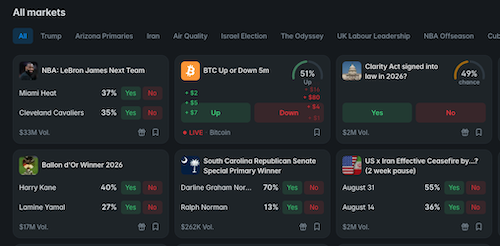
A prediction market is a place where people trade contracts based on what they think will happen in a future event. It works a little like a stock market, except that instead of buying shares in a company, you’re buying a position in an outcome, such as whether a certain team wins a game.
Platforms like Polymarket, ProphetX, and OG let users buy “yes” or “no” positions on all sorts of events, with sports accounting for a large share of the activity. DraftKings and FanDuel have entered this space as well, offering their own prediction market products — FanDuel Predicts and DraftKings Predictions — alongside their more traditional betting and DFS offerings.
With prediction markets, contract prices usually range from 1 cent to 99 cents, and that price reflects what the crowd currently thinks is likely to happen.
How contracts and pricing work
Say there’s a contract that asks whether a certain team will win its next game. If most traders think they will, the “yes” price might sit around 65 cents. Buy that contract and get it right, and you’re paid $1 per contract. Get it wrong, and the contract is worth nothing.
So if you bought 10 contracts at 65 cents each, you’d spend $6.50, and a correct outcome would pay you $10. That $3.50 gap is your profit.
How people actually win money
There are two main ways people make money here. The first is just holding a position until the event wraps up and hoping you picked the right side. The second is trading in and out before the event ends, buying low and selling high as the price shifts in response to new information.
That second approach is what makes prediction markets feel different from a typical bet. Some users never wait around for a final result at all. They watch the price move and cash out early the moment it swings in their favor.
What is a Pick’em site?
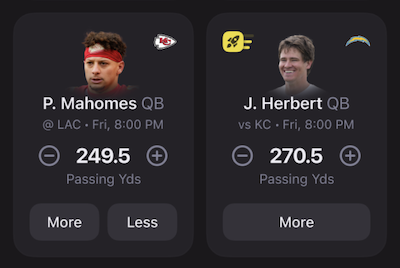
Pick’em platforms take a much simpler approach. Instead of trading anything, you’re just picking whether a player or team will go over or under a set line, or answering a straightforward yes-or-no question. You usually combine a few picks into one entry, and that entry has a fixed payout decided before you even submit it.
Betr Picks and DraftKings Pick6 are two of the more recognizable names in this space, and Underdog and PrizePicks have also built large followings with similar pick-based formats.
It’s worth noting that pick’em contests often run hand-in-hand with daily fantasy sports, and in a lot of cases they’re offered on the same platform. DraftKings, for example, offers Pick6 as a standalone product alongside its more traditional salary-cap DFS contests, and Underdog does something similar. So you’ll frequently see both formats living under one app rather than being offered by entirely separate companies.
How picks and payouts work
Once you choose your picks and lock in your entry, that’s it. There’s no adjusting anything afterward. The payout multiplier is set based on how many picks you include, so a three-pick entry might pay out at a lower multiplier than a six-pick entry, since more picks generally means more risk.
Standard vs. safer entry options
Most Pick’em platforms give you a choice between two entry styles. The standard option requires every single pick in your entry to hit for you to win anything, but it offers a higher payout. The safer option, sometimes called a “protected” or “insured” entry, still pays out even if one of your picks misses, just at a reduced multiplier. It’s a trade-off between higher risk and higher reward versus a bit of built-in cushion.
Key differences between prediction markets and pick’em contests
Once you see how each one works on its own, a few clear differences start to stand out.
What you’re actually predicting
With a prediction market, you’re betting on whether an event happens at all, like a game outcome or a broader real-world result. With Pick’em, you’re predicting individual player or team stat lines, which is a narrower, more specific type of prediction.
Locked in vs. flexible
This might be the single biggest difference between the two. Prediction markets let you buy and sell positions as the price moves, so you’re never fully stuck once you’re in. Pick’em entries lock the moment you submit them, with zero ability to adjust or exit no matter what happens afterward.
Regulation and legal status
Prediction markets fall under the Commodity Futures Trading Commission. This federal regulator is part of why platforms like Polymarket and ProphetX can operate in states where traditional sports betting isn’t available yet. However, that federal-only framing is currently being challenged. A federal appeals court ruled in September 2026 that states can also regulate sports event contracts, and the fight is expected to reach the Supreme Court.
Pick’em sites are regulated at the state level instead, so availability depends on where you live, and DraftKings Pick6 and Betr Picks aren’t necessarily accessible everywhere.
Market and contest variety
The range of things you can actually predict looks pretty different depending on which platform you’re using.
Prediction market categories
Beyond sports, prediction markets let you trade on politics, economic data, entertainment outcomes, and other current events. Within sports, markets are usually built around game winners, series results, or season-long outcomes rather than individual player stats.
Pick’em contest types
Pick’em sites stay almost entirely focused on sports. You’ll typically find player prop-style picks covering points, yards, rebounds, and similar stats, along with occasional team-based picks. Some platforms also run special contests during major events, but the format stays the same regardless of the sport.
Costs, fees, and payout structure
Neither option is free to use, and understanding how each one actually makes money helps explain what you’re paying for.
How prediction markets charge you
Most prediction markets charge fees tied to trading activity. That might include a small percentage on deposits, a fee per contract traded, or a wider spread on markets with low volume. Individually, these fees are usually small, but they can add up the more active you are.
How Pick’em platforms set payouts
Pick’em sites work differently. There’s typically no fee for depositing or withdrawing. Instead, the payout multiplier built into each entry already accounts for the platform’s cut, so you’re not charged separately. A five-pick entry might pay out at 10x for a standard entry, but that number already reflects the platform’s margin baked into the structure.
Getting started: sign-up and verification
Opening an account is usually the easy part, but how much you need to provide upfront varies widely between the two.
Opening a prediction market account
Signing up for a prediction market tends to take a little longer. Most platforms require identity verification right away, which means uploading a government ID and sometimes a selfie to confirm it matches the ID. This is standard on platforms like Polymarket and OG, and it can take anywhere from a few minutes to a couple of days.
Opening a Pick’em account
Pick’em sign-ups move faster. You’ll usually need basic information to get started, and full identity verification often isn’t required until you try to withdraw money. That means you can create an account and start making picks on Betr Picks or DraftKings Pick6 almost immediately.
Deposits, withdrawals, and wallets
Prediction markets often support both crypto and traditional payment methods, and some require managing a wallet, whether that’s built into the platform or an external crypto wallet you connect yourself. Withdrawal speed depends heavily on the method, ranging from minutes for crypto to a few business days for fiat transfers.
Pick’em platforms mostly stick to standard payment methods like debit cards, PayPal, and Venmo, with your balance held directly in your account rather than a separate wallet. Withdrawals typically take somewhere between one and five business days.
Flexibility: can you exit early?
This is one of the clearest practical differences between the two formats. On most prediction markets, you can sell your position any time before the event resolves. If the price moves in your favor early, you can lock in a profit and walk away without waiting for the outcome.
Pick’em doesn’t offer anything like that. Once your entry is submitted, you’re locked in until all picks resolve, whether that takes a few hours or several days.
Customer support experience
Prediction markets often rely on help centers and educational resources alongside live chat, since trading mechanics and contract settlement can require more detailed explanations than a simple entry-based platform. Response times vary depending on the complexity of the issue.
Pick’em platforms usually offer more straightforward support through email and live chat, and since the format itself is simpler, common issues tend to get resolved faster and more consistently.
Security and fund protection
Both types of platforms rely on protections such as two-factor authentication, and many now offer biometric login as an additional layer of security. The bigger difference is in how funds are actually held. Prediction markets can be platform-held or user-controlled, meaning you might keep funds in your own connected wallet rather than leaving them with the platform. Pick’em sites are platform-held across the board, so the site itself always holds your balance.
Security issues are rare in both categories, but it’s still worth using strong passwords and enabling every available security feature.
Pros and cons of prediction markets
Here’s a quick look at where prediction markets stand out and where they come up short.
Pros
Prediction markets bring a few real advantages, especially for users who want more control over their positions.
- Wide range of events beyond sports, including politics and finance
- Flexible trading with the ability to enter and exit positions
- Market-driven pricing that reflects real-time sentiment
Cons
That flexibility comes with a few trade-offs worth knowing about upfront.
- More complex for total beginners compared to simple pick formats
- Prices can shift quickly in lower-activity markets
- Availability can vary depending on your state
Pros and cons of pick’em sites
Pick’em has its own strengths and weaknesses worth weighing before you dive in.
Pros
There’s a lot to like if you want something quick and easy to jump into.
- Simple, easy-to-understand format
- Fixed payouts you know before submitting
- Fast sign-up with quick access to picks
- Strong mobile experience built for on-the-go use
Cons
At the same time, there are a few limitations that come with the simplicity.
- Limited almost entirely to sports
- No flexibility once picks are locked in
- Fewer event types compared to prediction markets
Which one should you choose?
There’s no single right answer since the two appeal to different kinds of users. If you like tracking probability, want the option to exit a position early, and enjoy markets that go beyond sports, a prediction market is probably the better fit. Polymarket, ProphetX, and OG are solid starting points, and DraftKings and FanDuel both offer their own versions if you’d rather stick with a familiar name.
If you’d rather make quick picks, know your payout upfront, and don’t want to manage a position over time, Pick’em is likely more your style. DraftKings Pick6 and Betr Picks are two of the biggest names to start with, while Underdog and PrizePicks offer similar formats if you want to compare a few options before settling in.