
Polymarket vs. Kalshi: Which Prediction Market Should You Use in October 2026?
Prediction market apps have exploded in popularity, giving everyday traders a way to put money behind their opinions on everything from politics to the weather, sports, and more. Two names dominate the conversation: Polymarket and Kalshi.
Both let you buy and sell contracts tied to real-world outcomes, and both now operate under federal oversight in the United States. But they got there in very different ways, and they still feel like different products once you start trading on them.
From there, we’ll get into how each one handles markets, money movement, fees, and support, since that ownership difference shows up everywhere.
Polymarket vs. Kalshi: Comparing Prediction Market apps
Before getting into the details, here’s a side-by-side snapshot of how the two platforms stack up.
| Feature | Polymarket | Kalshi |
|---|---|---|
| Founded | 2020 | 2021 |
| Regulator | CFTC, through Polymarket US, a licensed Designated Contract Market | CFTC |
| US Access | Polymarket US app (USD, KYC required); international site blocked for US IPs | Fully open to eligible US users, with some state-level restrictions |
| Funding | Cash via Polymarket US, or crypto (USDC) on the international site | Debit card, bank transfer, wire, Venmo, Google Pay, crypto |
| Market Count | Thousands, spanning nearly every category imaginable | Thousands, with heavy focus on sports and US-centric topics |
| Ongoing Promo | Referral program paying a share of referred traders’ fees | Referral program paying trading credits once a friend hits a trade threshold |
| Best For | Traders who want more markets and tighter pricing | Traders who want the most familiar, no-crypto experience |
That table covers the basics, but the real differences show up once you start comparing specific categories, starting with the markets themselves.
What Is Polymarket?
Polymarket is the largest prediction market in the world, known for letting traders bet on the outcome of just about anything: elections, Fed decisions, award shows, sports, and whatever else is dominating the news cycle. It started as a crypto-native platform open to traders worldwide, and after a few years of being off-limits to Americans, it’s now back in the US through a separate, regulated arm called Polymarket US.
Deposit $10, Get a $25 Trading Bonus
Live Trade with the Biggest Payouts at the Largest Prediction Market in the World
Bonuses and Promotions
Polymarket doesn’t run a traditional platform-wide welcome bonus, but new users signing up through our Polymarket promo code TRADELSR can get a $25 trading credit on a $10 first deposit.
Beyond that, Polymarket’s main ongoing incentive is a referral program for active traders:
- You earn 10% of the net trading fees generated by anyone who signs up through your referral link
- You earn an additional 5% on indirect referrals (people your referrals bring in)
- Rewards on a given referral run until they reach Platinum status or 30 days after signup, whichever comes first
- You need $10,000 in lifetime trading volume to start earning rewards (you can share your link before that — you just won’t earn until you cross the threshold)
- Payouts are daily, in pUSD
Legality & State Availability
Polymarket US operates under CFTC oversight, giving it a federal framework to trade nationwide. It’s legal in the following states: AK, AL, AR, AZ, CA, CO, CT, DC, DE, FL, GA, HI, IA, ID, IL, IN, KS, KY, LA, MA, MD, ME, MI, MN, MO, MS, MT, NC, ND, NE, NH, NJ, NM, NY, OH, OK, OR, PA, RI, SC, SD, TN, TX, UT, VA, VT, WA, WI, WV & WY
Since availability can shift as regulations evolve, it’s worth checking back here or confirming directly in the app before you sign up.
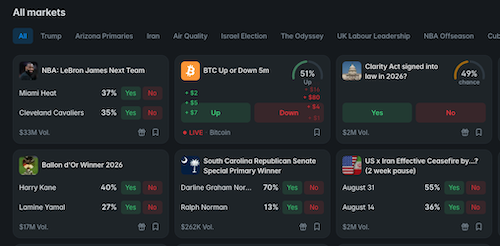
How to Sign Up for Polymarket
Polymarket now runs two separate products, so the sign-up process depends on which one you’re using. Here’s how it works for Polymarket US, the regulated option available to American traders.
- Click our Polymarket Promo Code link for a redirect to the registration page, then select the “Sign Up” button
- Enter your basic information, including your name, email, and Social Security number
- Complete identity verification (KYC), which typically confirms your ID within minutes
- Link your bank account and fund your balance in USD
- Browse markets and place your first trade
Players can also visit the app store or Polymarket’s website to register and begin trading. And if you’d rather use the international site, the process is simpler since it only asks for an email and a crypto wallet funded with USDC, but keep in mind that version is blocked for US IP addresses under Polymarket’s 2022 CFTC settlement.
What Is Kalshi?
Trade on Sports, Politics, and MORE
Largest Prediction Market in the US
Hundreds of Markets to Choose From
Kalshi is a CFTC-regulated exchange that’s carved out a reputation as the more traditional, US-focused option in the prediction market space. It leans heavily into sports and mainstream American news, and it’s built its platform around a simple, dollar-based trading experience with no crypto required.
Bonuses and Promotions
Enter promo code VAULTLS when you register. Kalshi offers new traders a $25 bonus following $25 in trades after registration and deposit.
Kalshi is legally available in: .
Legality & State Availability
Kalshi operates under CFTC oversight, giving it a federal framework to trade nationwide, but its state-by-state legal status is actively in motion rather than settled. Nevada ordered Kalshi to stop accepting wagers from state residents by August 12, 2026, and New York sued the platform over its sports-event contracts, with a federal judge initially siding with New York’s regulators before Kalshi appealed.
Other states could take similar action as these disputes play out, so rather than list specific states here, we’d recommend confirming your state’s current status directly in the Kalshi app or on Kalshi’s own site before signing up.
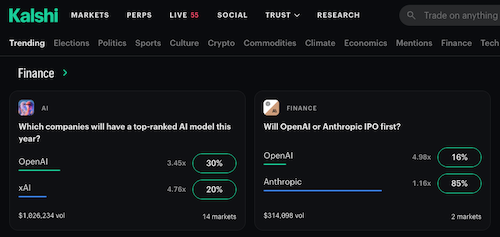
How to Sign Up for Kalshi
Kalshi has one straightforward sign-up path that doesn’t require a crypto wallet to create an account — crypto (USDC) deposits are available separately as a funding option once you’re signed up. Here’s what it looks like from start to finish.
- Click one of our Kalshi promo code links to get started
- Enter your basic information, including your name, email, and Social Security number
- Verify your identity, which usually only takes a few minutes
- Choose a funding method and deposit money into your account
- Browse markets and place your first trade
Once you’re verified, you’re free to deposit and start trading right away, without any additional waiting period. Traders can also go to Kalshi’s website or download the app to begin registration.
Polymarket vs. Kalshi: Markets & Sports Coverage
Market variety is one of the clearest differences between these two platforms.
Polymarket casts a wide net, covering politics, the Fed, award shows, tech and AI news, geopolitics, crypto prices, and pop culture moments as they happen in real time, alongside a sports lineup that now includes global soccer and other international events.
Kalshi covers similar ground in politics, economics, weather, and culture, but its center of gravity is US sports and American news cycles, with deep coverage across the NFL, NBA, MLB, NHL, and college sports.
In short, Kalshi is built around what a US sports fan already follows, while Polymarket casts a much wider net across global events and is quicker to launch a market the moment a story breaks anywhere in the world.
Polymarket vs. Kalshi: Deposits & Withdrawals
Getting money in and out looks fairly different depending on which platform you’re using.
Deposits
Polymarket accepts crypto deposits on its international platform, plus card funding through partners like MoonPay. Polymarket US, built for the domestic market, lets you fund your account in plain USD straight from your bank, with no crypto wallet required.
Kalshi offers more built-in variety from the start, accepting debit card, bank transfer, wire transfer, Venmo, Google Pay, and crypto deposits, so you can fund an account with whatever payment method you already use.
Withdrawals
Withdrawing from Polymarket’s international site sends funds back out in crypto, while Polymarket US pays out in USD through your linked bank account. Kalshi withdrawals by bank transfer can take a few days to clear, while crypto withdrawals tend to process faster.
Kalshi also charges a flat fee on debit card withdrawals, something to keep in mind if you plan on moving money in and out frequently.
Fees & Liquidity: Polymarket vs. Kalshi
With both platforms covered individually, this is where the differences actually show up once money is on the line.
Fees
Polymarket charges a taker fee that scales with how close a contract is to a coin flip, and the rate depends on the category. Fee-bearing categories top out at roughly $1 to $1.75 per 100 shares traded at even odds, and some categories, like geopolitics, are currently fee-free entirely. Limit orders are free, and you can even earn a rebate for placing them.
Kalshi uses a flat fee formula tied to contract price, generally landing around 1 to 2 cents per contract on a typical trade, with cheaper fees on limit orders as well, plus a small percentage on debit card deposits. Neither platform nickel-and-dimes you the way a traditional sportsbook does with its odds, but Polymarket’s structure tends to come out cheaper for most trade sizes, especially for traders who use limit orders regularly.
Liquidity
On its biggest markets, Polymarket is genuinely hard to beat. Its major political and global event contracts have handled staggering trading volume, and that depth keeps prices tight even when huge sums move through a single market, with its largest contracts rivaling the volume of a small stock during marquee events like elections or the World Cup.
Kalshi has caught up in overall trading volume and now leads on total monthly dollars traded, largely thanks to its sports lineup, and its flagship sports and political markets are plenty liquid in their own right. The honest takeaway is that liquidity depends on what you’re trading. Polymarket’s depth is tough to match on the biggest global events, while Kalshi holds its own just as well on everyday US sports contracts.
Polymarket vs. Kalshi: Best Features of Each Prediction Market Site
Both platforms have a few things that genuinely set them apart from the rest of the field.
Polymarket
- Deepest liquidity on major events: its top political and global event contracts have handled staggering trading volume, keeping prices tight even when large sums move through a single market
- The broadest market menu around: between politics, crypto, culture, tech, and global sports, there’s almost always a market for whatever’s happening in the news
- Low fees with maker rebates: limit orders are free to place, and active traders can earn a rebate for adding liquidity instead of taking it
- Backing from a Wall Street giant: Polymarket landed a multibillion-dollar investment from Intercontinental Exchange, the company that owns the New York Stock Exchange
Those strengths are largely about scale and reach, while Kalshi’s advantages come from a more focused, dollar-first approach.
Kalshi
- A dollar-based trading experience: everything settles in USD, with no crypto wallet, gas fees, or blockchain terminology to learn
- Deep US sports coverage: one of the more complete sports lineups in the space, covering all the major US leagues plus college sports and international soccer
- A longer regulatory track record: Kalshi has operated under CFTC oversight longer than any other major prediction market
- Flexible, familiar payment methods: support for Venmo, Google Pay, and standard bank transfers makes funding an account feel like using any other app already on your phone
Big infrastructure moves are one thing, but it’s worth knowing what actually happens if you hit a snag while trading on either platform.
Polymarket vs. Kalshi Customer Support Comparison
Both platforms offer multiple ways to get help, but the experience of actually using them is fairly different.
Polymarket
Polymarket leans on an AI-driven live chat, an FAQ library, and an active Discord community where traders talk strategy and flag issues in real time. That AI support has generally been responsive to specific questions rather than just serving up canned answers, so simple questions tend to get resolved quickly.
Kalshi
Kalshi offers live chat, email, and an extensive FAQ, and it markets its support team as US-based and staffed by actual people. That can mean a longer wait for a reply compared to an AI-driven chat, but you’re guaranteed to be talking to a human when you get one.
Final Verdict: Polymarket or Kalshi?
Final Verdict: Polymarket or Kalshi?
Both platforms are legitimate, CFTC-regulated ways to trade on real-world events, and plenty of serious traders keep accounts on both. But if you’re picking one platform to start with, Polymarket is our recommendation for most traders.
Polymarket offers the broadest set of markets anywhere, from politics and the Fed to award shows, tech, crypto, and global sports, so there’s almost always a market for whatever’s happening in the news. It also tends to come out cheaper on fees, with free limit orders and rebates for active traders, and its biggest political and global event contracts carry deeper liquidity than you’ll find almost anywhere else. That combination, plus a multibillion-dollar backing from Intercontinental Exchange, the company that owns the New York Stock Exchange, gives it a real edge for traders who want more than just the basics.
Kalshi is still worth considering if you want the simplest possible setup, prefer sticking to dollars, and mostly care about mainstream US sports and news. But for traders who want the widest range of markets, sharper pricing, and deeper liquidity, Polymarket is the platform built for that.