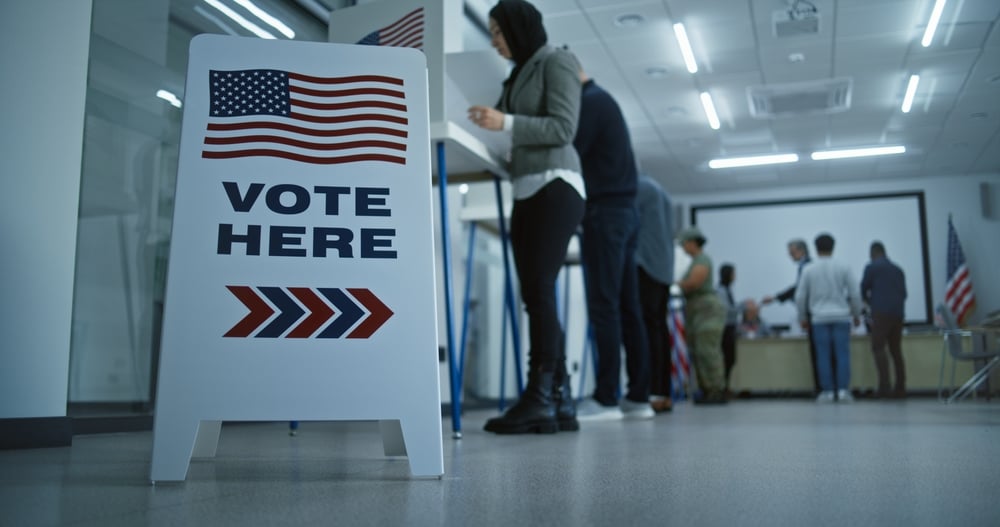
A federal judge refused to block a Wisconsin law barring residents from voting in elections they have wagered on, leaving the nearly 180-year-old restriction in place as voters head to the polls Tuesday for the midterms.
U.S. District Judge Byron Conway denied a preliminary injunction Monday sought by Wisconsin radio host Joseph Giganti Sr., who challenged the law after state election officials warned that trading election contracts on prediction markets could jeopardize residents’ voting eligibility.
Conway cited the state’s interest in preventing financial incentives from influencing voters, writing that “voting for a candidate based on the payoff the voter stands to gain from a prediction contract is inconsistent with proper democratic functioning.”
The ruling comes as nearly $1.9 billion has been traded on the 2026 midterms through Kalshi and Polymarket, marking the first midterm cycle since a 2024 court decision opened the door to widespread election trading.
Judge rejects voting rights argument
Giganti, host of The Regular Joe Show, sought to purchase contracts on Polymarket tied to Wisconsin’s gubernatorial and congressional elections while retaining his right to vote.
He argued that applying the law to prediction markets would violate his constitutional voting and free speech rights. He also intended to discuss his trades and preferred candidates on his radio program.
Conway rejected the argument that the restriction threatened Giganti’s right to vote, noting that he had not purchased any contracts and therefore faced no immediate risk of having his ballot challenged. Instead, the judge found that the law restricted Giganti’s ability to purchase election contracts, an activity that is not constitutionally protected.
Wisconsin election integrity concerns
Conway also warned that election wagering could be used to circumvent laws against vote buying.
“By skewing the odds, a person taking the bet can essentially buy the voter’s vote through a scheme disguised as a bet,” he wrote.
Citing an 1857 Wisconsin Supreme Court decision warning against elections becoming instruments of gambling, Conway found that the state’s interest in preventing such conduct outweighed Giganti’s potential harm.
The ruling does not determine whether prediction market contracts legally constitute wagers under Wisconsin law, a question Conway acknowledged remains unresolved. He accepted the state’s interpretation solely for purposes of deciding the injunction request.
Wisconsin law restricts bettors from voting
The case stems from a July warning by the Wisconsin Elections Commission that residents who bet on an election and subsequently vote in that contest could face ballot challenges and potential criminal prosecution.
The restriction dates to 1849 and prohibits anyone with a direct or indirect interest in a wager on an election’s outcome from voting in that election.
Kalshi and Polymarket have disputed the commission’s interpretation, maintaining that their event contracts are federally regulated financial instruments rather than gambling products. Kalshi accused the commission of “voter suppression,” while Polymarket said it would address the claims through the legal process.
How election betting became legal
Election betting remains restricted in 32 states, including 23 states that prohibit the practice outright, according to a June analysis by Pew Research Center,
Kalshi began offering contracts on the 2024 presidential election, following a court victory that same year defeated a challenge from the CFTC. The CFTC later dropped its appeal in May 2025.
Under President Donald Trump, the CFTC has aggressively defended its authority over prediction markets as the industry has boomed. Kalshi’s valuation has soared from $2 billion to $40 billion in a little over a year, while Polymarket’s has climbed from roughly $1 billion to $15 billion. Kalshi has recorded more than $371 billion in trading volume since launching sports contracts in January 2025, with sports accounting for roughly 85% of that total.
The CFTC is suing several states, including Wisconsin, to defend its authority over event contracts, as part of a broader legal battle with more than 20 states over whether sports contracts constitute gambling subject to state laws or financial instruments under federal oversight.