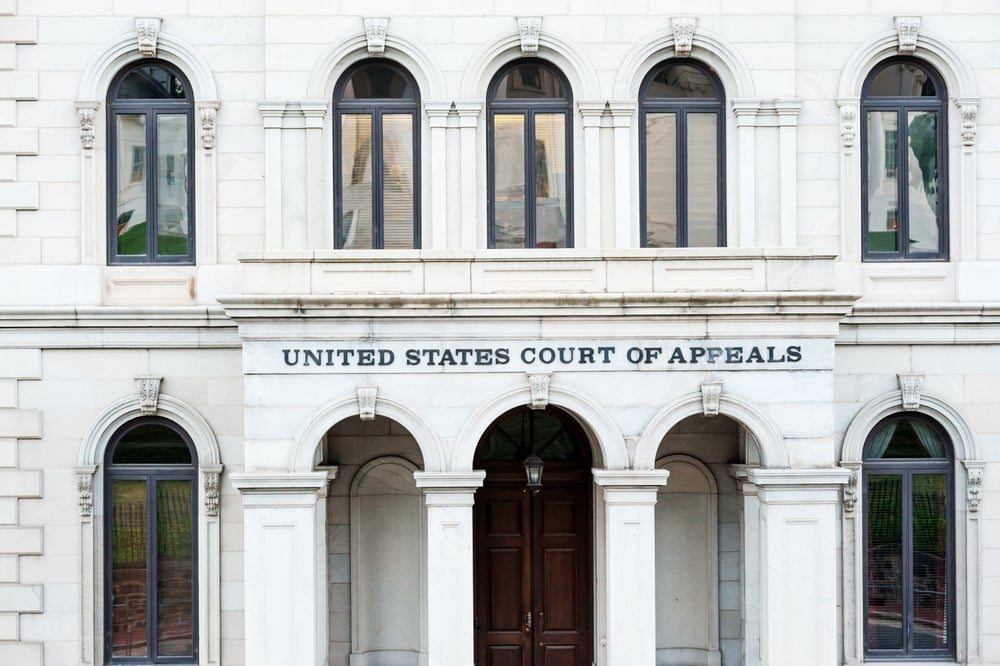
The Fourth Circuit has affirmed the Maryland district court’s decision to deny a request by Kalshi for a preliminary injunction that would prevent state officials from enforcing state gambling laws against its sports event contracts.
Tuesday’s published decision is a per curiam opinion was split between the three judges. Judges Roger Gregory and Stephanie Thacker affirmed the decision but Judge DeAndrea Benjamin dissented, so there isn’t one shared majority opinion explaining why Kalshi loses.
The per curiam section itself only contains the court’s disposition: “The judgment of the district court is AFFIRMED.”
The ruling drew a positive reaction from Better Markets, which filed an amicus brief in the case backing Maryland’s position. Legal Director Dominick Freda praised the decision and pointed to similar outcomes in the Sixth and Ninth circuits.
“The judges in the majority just couldn’t agree on which of Kalshi’s arguments to avoid state gambling laws was worse,” Freda said. “That’s because a bet on who wins Sunday’s game is a sports bet. It was a sports bet before Kalshi, and it is a sports bet now.”
Kalshi, MD dispute dates back to early 2025
The case itself began on April 7, 2025, when the Maryland Lottery and Gaming Control Commission sent Kalshi a cease-and-desist letter, giving the company 15 days to stop offering sports event contracts in the state after it had self-certified those contracts for its prediction markets product in Jan. 2025. Maryland argued that Kalshi was offering sports wagering without the required state license.
Kalshi subsequently filed its federal lawsuit against Maryland officials on April 21, 2025, arguing that federal commodities law preempts the state’s regulatory authority.
The request for a preliminary injunction was initially denied by U.S. District Judge Adam Abelson on Aug. 1, 2025. Abelson assumed for purposes of the analysis that Kalshi’s contracts could qualify as swaps, and that Kalshi had not shown that the Commodity Exchange Act displaced Maryland’s gambling laws.
At the same time, the court also rejected the argument that the state and federal regulatory requirements were incompatible. Kalshi could, in principle, comply with the CEA while also seeking a Maryland sports wagering license.
Affirming judges disagreed on points
The two judges agreed on the overall outcome of affirming the denial but disagreed elsewhere, which may be why the disposition was straightforward.
Gregory did not decide whether Kalshi’s sports event contracts qualify as swaps under the CEA. Instead, he only assumed they did for the sake of his analysis and concluded that it still did not establish that Congress intended to remove Maryland’s gambling regulation authority.
The lack of a decision is an important underscore because, while Kalshi argues that its CFTC registration and self-certification give it federal protection, he questions whether that establishes that the contracts are entitled to immunity from state gambling laws.
On conflict preemption, Gregory found no reason Kalshi couldn’t comply with both federal and state regulations – or, in other words, also seek a state license.
Thacker reached the same result, but through a different interpretation of the CEA. Her concurrence focused on the statutory definition of a swap and whether the payment obligation depends on the occurrence or nonoccurrence of an event. Because Kalshi’s contracts pay out based on the outcome of a sports event, she concluded that they do not qualify as swaps under the CEA.
“Nothing in the CEA or the CFTC’s regulations converts agency inaction into a determination carrying sweeping preemptive consequences,” stated Gregory in the Fourth Circuit opinion. Thacker added, “What is happening here is sports betting.”
Dissent: contracts are CFTC regulated swaps
Benjamin disagreed with both concurring judges. She concluded that Kalshi’s contracts qualify as swaps because their payments depend on the outcome of an event with economic consequences.
Because she viewed the contracts as swaps, she concluded that the provision in the CEA that grants exclusive jurisdiction should prevent Maryland from regulating them.
AG: Kalshi must meet sportsbook standards
Maryland Atty. Gen. Anthony Brown said Wednesday that Kalshi must now be as safe as the legal sportsbooks regulated and licensed in the state.
“When betting platforms operate outside State oversight, Marylanders lose the protections that keep gambling fair and safe,” Brown said in a statement. “Under our licensing laws, sportsbooks must safeguard customer data, refrain from deceptive advertising, and stop marketing to people who are barred from betting or at risk of gambling harm. Federal commodities rules were never designed to provide those safeguards.
“Today’s ruling means Kalshi must meet the same consumer protection standards as every other sportsbook serving Maryland residents. Our Office will continue to defend those protections and the families they keep safe.”
Fourth Circuit deepens split against predictions
As more circuit court decisions come in, overall rulings on CEA preemption continue to differ.
The Third Circuit ruled in Kalshi’s favor, affirming preliminary relief that prevents New Jersey from enforcing its gambling laws against the company.
The Sixth Circuit held that the contracts did not qualify as swaps and affirmed the denial of an injunction in the Ohio dispute and vacated the injunction Kalshi had obtained in the Tennessee dispute.
The Ninth Circuit also ruled against Kalshi’s effort to obtain preliminary relief, and the Second Circuit denied requests for injunctions pending appeal.
Now, this Fourth Circuit decision adds another appellate loss for Kalshi, despite the lack of a unified majority opinion.
New Jersey has already petitioned the Supreme Court to review the Third Circuit’s decision, and Kalshi’s response to that petition is currently due Dec. 7. This latest ruling gives state officials another appellate decision to cite in support of their position, but it does not guarantee the Supreme Court will take the case.