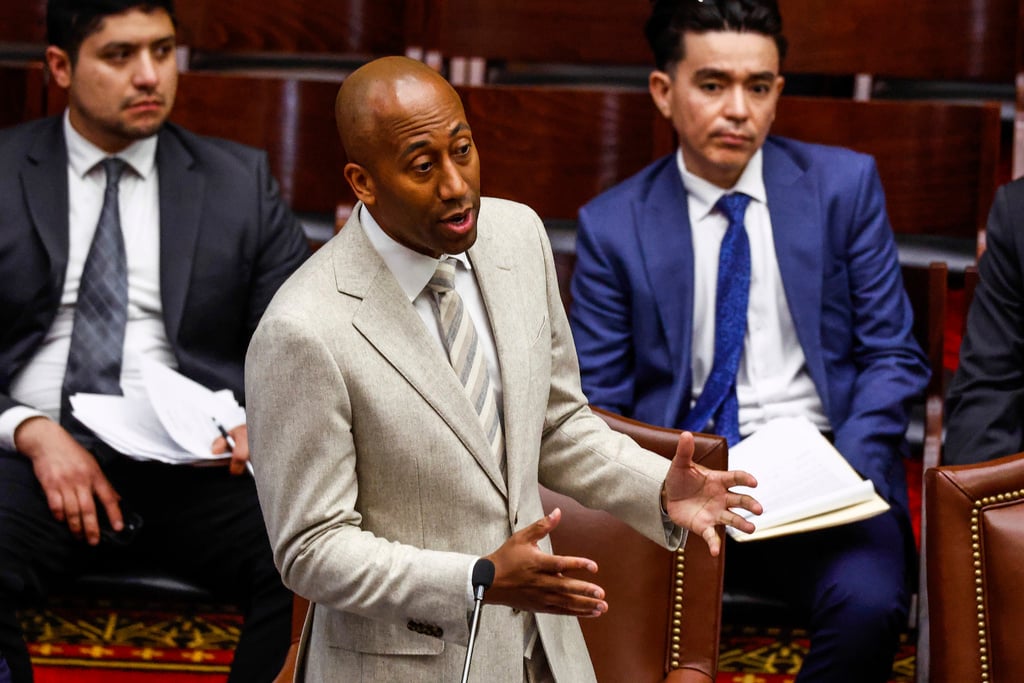
New York Assemblyman Clyde Vanel is putting forward one of the first state legislative efforts to ban predictions on various categories.
A 9251, known as the Oversight and Regulation of Activity for Contracts Linked to Events Act or “ORACLE Act,” bans “certain categories of bets that are contrary to public policy,” Vanel’s office said in a Monday press release. New York’s 2025 legislative session is over, meaning this bill can be acted on when the 2026 session opens Jan. 7.
Banned predictions categories would include activities of public officers, war, natural disasters, disease and sports. Vanel noted that prediction trading is the latest attempt to call gambling something else.
“Like the pre-flipper pinball machines, sweepstakes cafes, sweepstakes gambling, and many other schemes that preceded it, prediction markets have rebranded old-fashioned wagering as ‘trading,’” Vanel said. “We are already seeing extremely suspect cases where insiders are trading on embargoed information, we are seeing markets that can be influenced by single actors, and we are even seeing markets that relate to war, terrorism and natural disasters.”
Can NY limit predictions?
Prediction markets like Kalshi or Polymarket are regulated at the federal level by the Commodity Futures Trading Commission, meaning they can be traded in all 50 states.
That has not stopped multiple state’s gambling regulators, including New York’s, from sending cease-and-desist letters to the operators or even taking them to court. Regulators have mostly agreed that sports predictions are nothing more than unregulated sports betting.
“The State not only can regulate these markets, but they must,” Vanel said. “Here’s the blunt reality: if you want to run what is, in substance, a gambling platform in this state, you get a license. You open the books. You submit to oversight. You prove to the residents of every state you operate in that you actually care about whether they spend more than what they can afford, that you are providing them with resources to help with addiction, and that you have real guardrails against insiders harming them.
“Yet, prediction markets have done none of that. They’ve wrapped wagering in new jargon and skipped the hard part: licensure and accountability. That’s why states can’t look the other way.”
Survey: Americans want predictions access
Nearly 90% of voters believe Americans should have access to prediction markets, according to survey results released by Kalshi.
The survey of 1,219 nationwide voters by Axis Research was conducted Sept. 18-23. Neither Kalshi nor Axis Research responded to requests for the full survey.
The survey reportedly received majority support for multiple statements likening sports prediction markets to financial trading and not gambling:
- “Prediction markets are aggregating information from thousands of individuals to produce a real-time probability of a sports outcome and should be considered analysis more than gambling” (63%).
- “Participating in a sports prediction market requires knowledge and analysis similar to financial investing, rather than chance-based gambling” (60%).
- “Sports prediction markets create a public good by producing forecasts useful to the media, leagues, and owners” (59%).