Kalshi is trending sharply upward as football betting season begins in the US.
Trading volume on the prediction platform topped $300 million over the weekend, including $196 million on Sunday alone. It was the third-biggest day ever for Kalshi and its busiest since the election last November.
More than 95% of all trading involved sports contracts, which the site launched nationwide earlier this year. These contracts mimic sports bets but are federally regulated as commodities and therefore legally available for trading in all 50 states.
Football powers Kalshi’s production
Football trading alone surpassed a quarter of a billion dollars.
College football set the bar on Saturday, producing $85.1 million in single-day volume. The Michigan vs. Oklahoma game ticked over $10 million by itself and was the only college game to reach eight figures this week. Three college games crossed that threshold last week without much competition.
The Saturday simmer became a full boil on Sunday, with 13 NFL games accounting for $161 million in combined trading. The primetime matchup between the Baltimore Ravens and the Buffalo Bills alone generated $35.6 million in volume, twice as much as any other game. Nine of the weekend’s NFL games eclipsed $10 million.
The season opener last Thursday saw $20.1 million in volume, and Friday’s island game reached $25.7 million – the third- and second-largest games of the week for traders.
As big as these numbers are, they still represent just a fraction of the total betting handle from regulated US sportsbooks.
Don’t call Kalshi a sportsbook
The surge in volume for football event contracts coincides with major platform updates that bring Kalshi’s trading experience closer than ever to traditional betting.
The site last week introduced a new six-box layout that is not exactly revolutionary, mirroring the way modern sports betting apps present the moneyline, spread, and total. It even uses American odds rather than contract prices that are typically standard for prediction markets.

Kalshi has also added limited player props and a small set of premade parlays to their list of available markets, further blurring the lines between trading and betting.
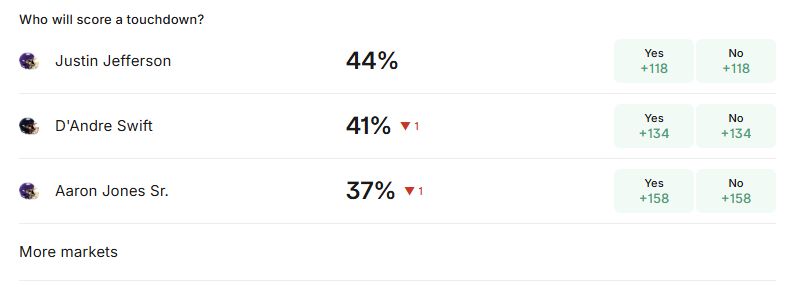
Trading volume is not a direct analog for sportsbook handle, and those secondary sports markets are not yet popular in the realm of event contracts. Anytime Touchdown markets were the most-traded prop this past weekend, yielding just $783,000 in volume.
Tennis pops on prediction platforms
The finals of the US Open for tennis were also popular among traders on Kalshi.
The men’s final between Jannik Sinner and Calos Alcaraz drew $19.6 million in trading over the weekend, outpacing all college football games. It was, in fact, the second-most traded match behind that Sunday Night Football thriller. Total lifetime volume for this market reached $35.4 million to crack the top 20 largest sporting events in the platform’s brief history.
The women’s final between Aryna Sabalenka and Amanda Anisimova was meanwhile just outside the weekend’s top 10, generating $8.93 million in trading on Saturday and more than $20.0 million in lifetime volume dating back to its open in mid-May.
One other tennis market saw action this weekend: odds for Novak Djokovic to win a major this year have officially dropped to zero with his semifinal loss to Alcaraz in the final grand slam of 2025.
Both tennis and golf are disproportionately popular on trading exchanges like Kalshi.
Competition incoming for Kalshi
Kalshi is not the only federally regulated prediction platform, but it was an early mover in what is becoming a hotly contested segment.
It first opened for business in July 2021 following approval from the Commodity Futures Exchange Commission, which oversees futures markets at the federal level. The CFTC’s self-certification mechanism ultimately facilitated the launch of Kalshi’s first sports contracts earlier this year, transforming their business and their bottom line essentially overnight.
Competitors, including existing sports betting brands, are now scrambling to enter the space lest Kalshi establish a firm foothold.
- Polymarket is imminently returning to the US three years after voluntarily exiting due to legal pressure that has since dissipated.
- Underdog has gone live with a prediction product in 16 states via Crypto.com and its federally registered exchange.
- FanDuel has announced a joint venture with CME Group to launch event contracts through its exchange. Regulatory caution will keep these contracts limited (at least initially) to non-sporting events like economic markets.
- DraftKings CEO Jason Robins thinks it will be hard for prediction platforms to compete with sportsbooks, but that hasn’t stopped his company from dabbling. DraftKings has taken the preliminary step of registering with the National Futures Association (NFA), reportedly in talks to acquire a startup called Railbird Exchange.
- Fanatics and PrizePicks are also registered with the NFA in an apparent first step toward prediction products of their own.
These new products could be especially useful in California and Texas, two markets with massive unmet demand from the continued absence of state-regulated sports betting.